
A Deep Dive into NVIDIA Cosmos and Its Capabilities
Training data scalability has been a barrier to the development of Physical AI, a field of systems with sensors and actuators to view and interact with the physical world. This constraint is addressed by NVIDIA's Cosmos World Foundation Model (WFM) Platform, which builds digital twins of the actual environment and the AI agent. A flexible framework for simulating, training, and optimising Physical AI systems in a variety of domains, Cosmos offers high-ceiling pre-trained models that are open-source.
This article explores the architecture, training process, and applications of NVIDIA Cosmos, showing how it opens the door to revolutionary advancements in autonomous driving, robotics, and other fields.
Table of Content
- What is NVIDIA Cosmos?
- Key Features and Innovations
- Architecture of Cosmos WFMs
- Training and Fine-Tuning Methodologies
- Testing Nvidia Cosmos capabilities
- Applications in Physical AI
What is NVIDIA Cosmos?
The Cosmos World Foundation Model Platform is a comprehensive solution designed to simulate real-world environments for Physical AI systems.It gives developers access to a secure, scalable digital framework for training, assessing, and optimising AI policies. Key Offerings include A Pre-trained and post-trained WFMs using state-of-the-art diffusion and autoregressive models., A robust video data curation pipeline for high-quality training datasets. and tools for producing synthetic data customised to specific uses.
Cosmos accelerates innovation in fields where real-world testing is risky or impractical by facilitating smooth interaction between digital twins of AI agents and their environments.
Key Features and Innovations
Generalist to Specialist WFMs
Cosmos adopts a pre training and post training paradigm:
Pre trained WFMs: Generalist models trained on 100M video clips capturing diverse physical dynamics.
Post trained WFMs: Finetuned for specific applications such as robotic manipulation, autonomous driving, and camera control.
Video Tokenization
Utilizing advanced tokenization techniques, Cosmos encodes videos into compact, trainable representations while preserving critical visual and physical details.
Guardrail System
Ensuring safe deployment, Cosmos incorporates pre- and post-guards to block harmful inputs and outputs.
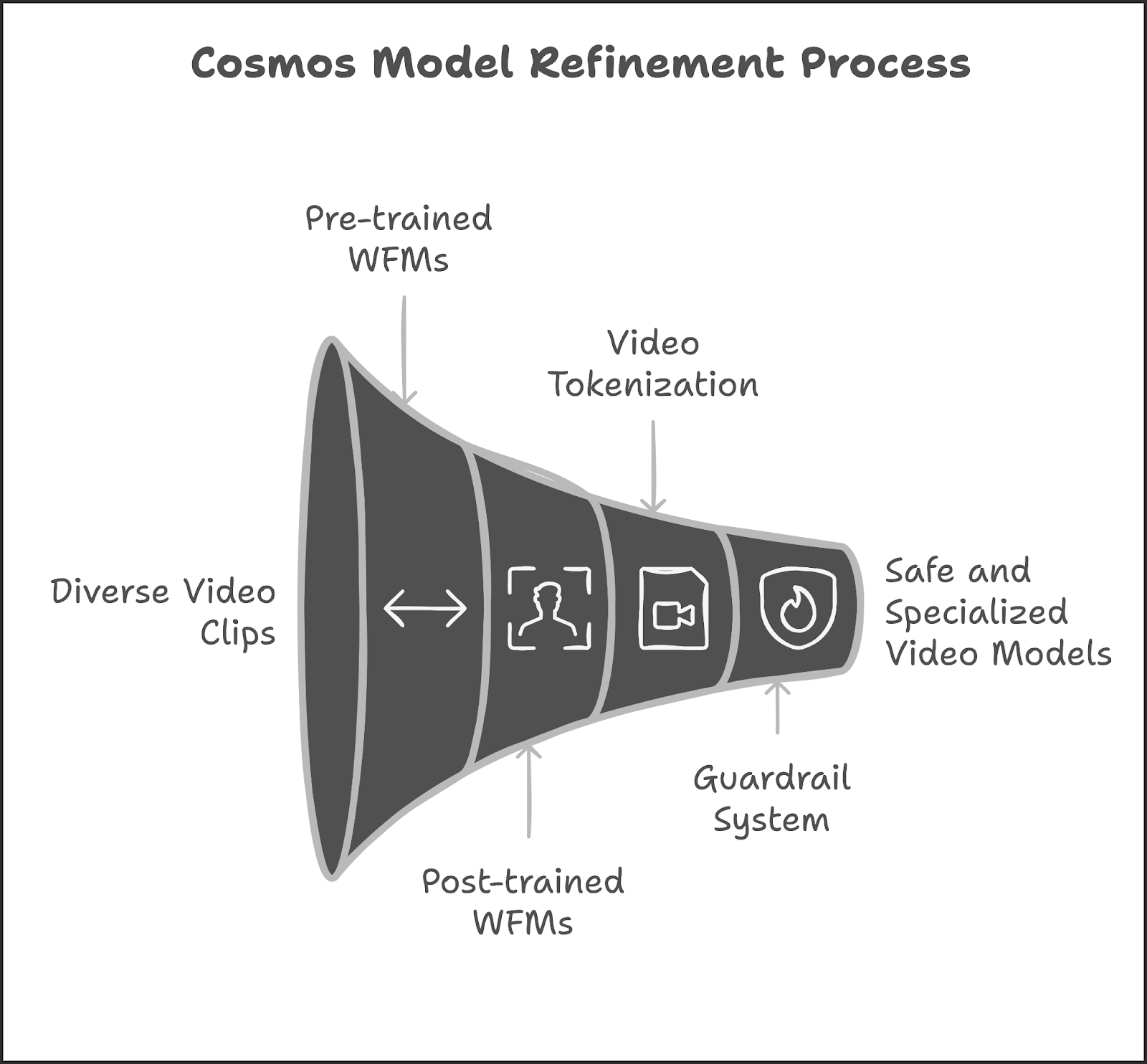
Nvidia Cosmos Refinement Process
Architecture of Cosmos WFMs
Cosmos-1.0-Diffusion-7B-Text2World is a diffusion transformer model designed for video denoising in the latent space. The network is composed of interleaved self-attention, cross-attention, and feedforward layers as its building blocks. The cross-attention layers allow the model to condition on input text throughout the denoising process. Adaptive layer normalization is applied before each layer to embed time information for denoising.
When an image or video is provided as input, their latent frames are concatenated with the generated frames along the temporal dimension. Augment noise is added to conditional latent frames to bridge the training and inference gap.
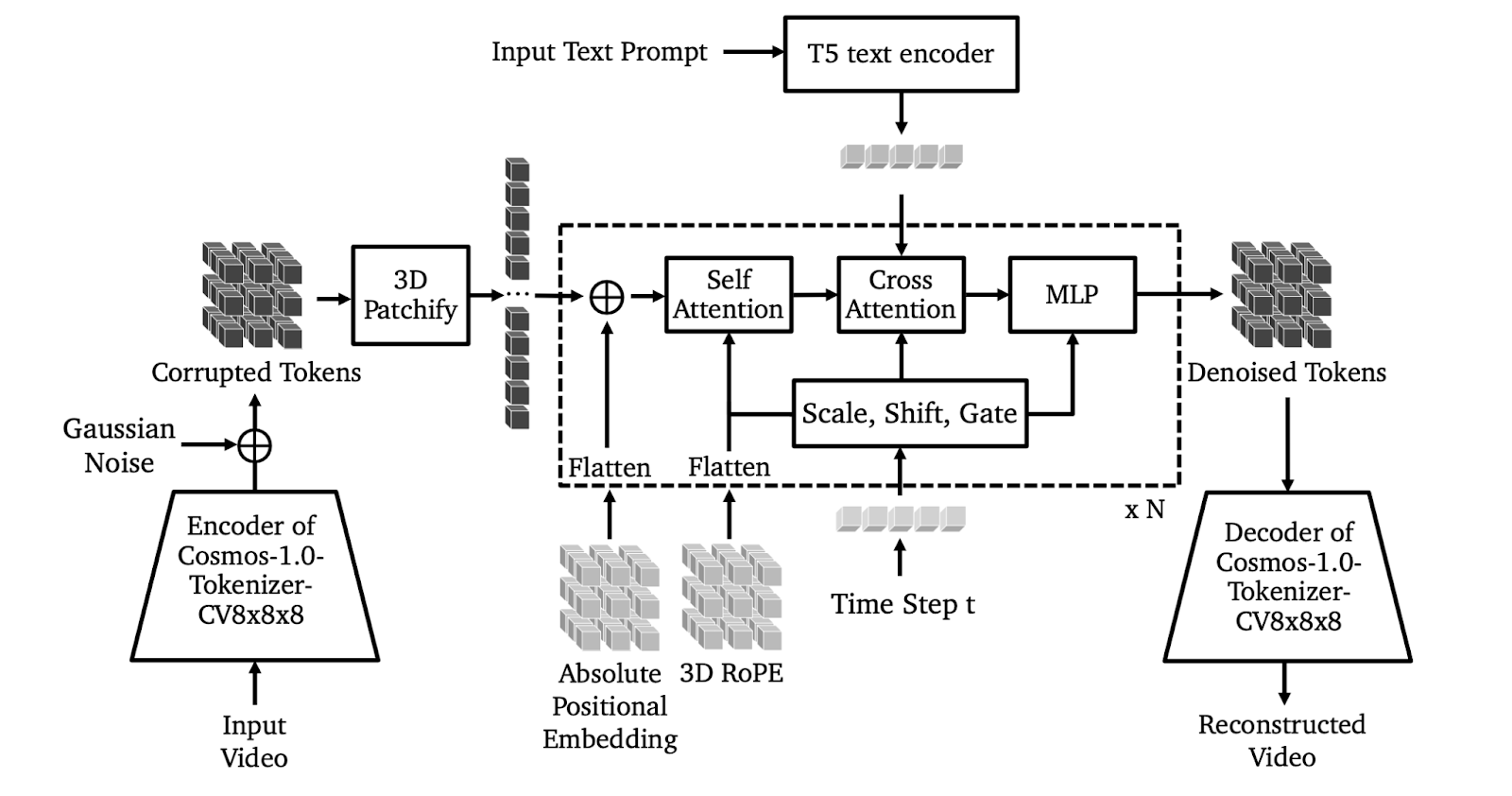
Nvidia Cosmos's Architecture
Training and Fine-Tuning Methodologies
Data Curation Pipeline
Dataset Size: 20M hours of videos, curated into 100M high-quality clips ranging from 2 to 60 seconds.
Processing Steps: Shot detection, motion filtering, visual quality assessment, and semantic deduplication.
Training Workflow
Pre-training: WFMs are trained on large-scale datasets to capture diverse visual and physical dynamics.
Post-training: Models are fine-tuned on domain-specific datasets with significantly fewer samples, optimizing them for specialized tasks.
Computational Efficiency
With hardware-accelerated transcoding and tokenization, Cosmos achieves unprecedented training throughput, utilizing over 10,000 NVIDIA H100 GPUs.
Inference Time and GPU Memory Usage
The table below presents the maximum observed GPU memory usage during end-to-end inference and runtime on a single H100 GPU:
| Offloading Strategy | 7B Text2World | 14B Text2World |
| Offload prompt upsampler | 74.0 GB | > 80.0 GB |
| Offload prompt upsampler & guardrails | 57.1 GB | 70.5 GB |
| Offload prompt upsampler & guardrails & T5 encoder | 38.5 GB | 51.9 GB |
| Offload prompt upsampler & guardrails & T5 encoder & tokenizer | 38.3 GB | 51.7 GB |
| Offload all components | 24.4 GB | 39.0 GB |
| Model Variant | Runtime |
| 7B Text2World (offload prompt upsampler) | ~380 seconds |
| 14B Text2World (offload prompt upsampler, guardrails) | ~590 seconds |
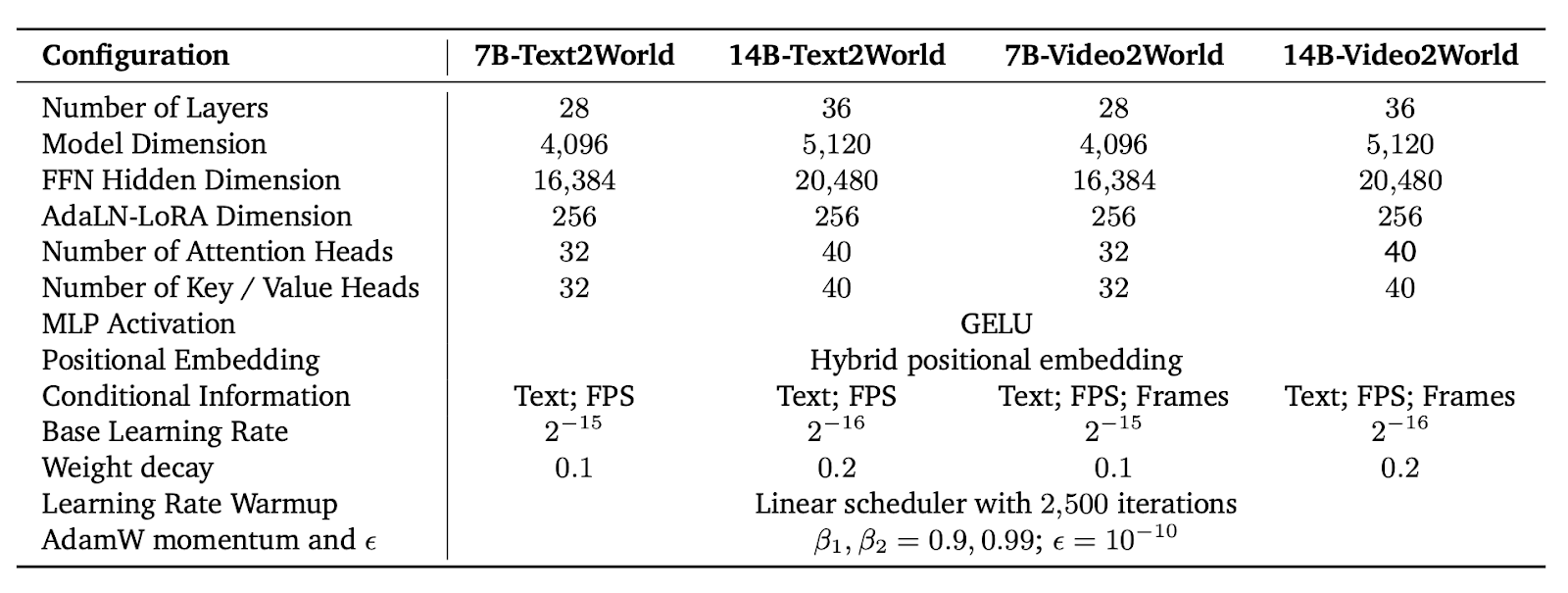
Configuration of Cosmos-1.0-Diffusion models.
Testing Nvidia Cosmos capabilities
Prompt
First-person view from a car's dashcam driving down a two-lane suburban neighborhood street. The perspective is forward-facing, showing a rainy day with gray clouds overhead. The road has puddles reflecting the sky, and windshield wipers flash intermittently. On either side of the street are charming houses with green grass lawns, flower gardens, and large oak trees. People walk on the sidewalks, some holding umbrellas, while others walk dogs or interact with pets like cats and small dogs near the homes. The scene feels lively and vibrant despite the overcast weather.Output
Applications in Physical AI
Robotic Manipulation
Cosmos enables robots to predict outcomes of actions in complex scenarios, enhancing their ability to interact with objects dynamically.
Autonomous Driving
Pre-trained WFMs are finetuned to simulate diverse driving conditions, facilitating robust autonomous vehicle training.
Policy Training and Evaluation
Cosmos WFMs allow developers to test AI policies in virtual environments, reducing risks and costs associated with real-world deployment.
Synthetic Data Generation
Using WFMs, developers can generate customized datasets for applications such as Sim2Real transfer learning.
Final Words
NVIDIA Cosmos represents a major shift in the development of Physical AI, offering an end-to-end platform for simulating and training intelligent systems. Its innovative architecture, robust training methodologies, and diverse applications make it a cornerstone for researchers and developers aiming to solve complex physical challenges with AI.